
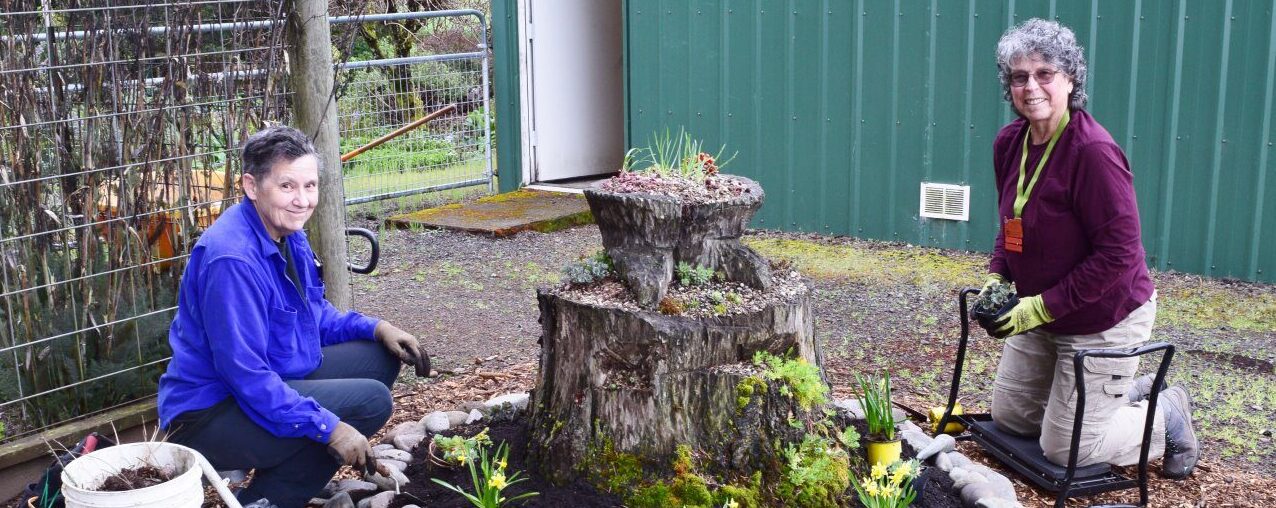
Using an existing natrual structure to elevate a garden space
Before my time at Extension, a tree was cut down near our green barn at the Discovery Garden. Left behind after the tree was felled was a stump, standing about three feet tall. Between the time it was cut down and the time I arrived, someone transformed this remnant into a structural art piece. The top foot of the stump was carved out to resemble a planter, and succulents were installed at the very top. Over time, this small garden became part of the visual landscape I see every time I visit the Discovery Garden and—maybe I should be embarrassed to say—began to blend in with the “usual sights.”
However, gardens are not stagnant spaces. In fact, they are often the opposite, filled with living, changing plants throughout the year. Even this stump followed the same philosophy. This year, Tasha King and Kish Doyle took on the project of revitalizing the space while still utilizing the stump as the main focal point of the garden.
They began by refreshing the planting space carved into the top of the stump—a shallow hollow that holds soil and allows plants to grow directly from the old wood. Slightly elevated above ground, the stump serves as a natural raised planter, improving drainage while giving the plants visibility and structure.
While the garden uses the stump as its focal point, Tasha and Kish built the space outward from it. A circular bed took shape around the base, edged with smooth stones that define the area and help keep mulch and soil in place. New, bright flowers were planted in the surrounding ground, creating a layered design that draws the eye inward while making efficient use of a compact area.
This garden is visually engaging and subtly provides several educational lessons. The stump anchors the garden visually, acts as a planter, and remains in contact with the soil so it can slowly decompose over time. As the centerpiece breaks down, it will offer new planting opportunities while retaining moisture and contributing organic matter to the surrounding soil. Its rough surface and crevices also support insects and soil life, adding ecological value alongside beauty.
This garden demonstrates another important lesson: existing landscape features do not have to be obstacles. Tree stumps can be repurposed as planters, informal raised beds, or central design elements—especially in small spaces where every square foot matters. By planting into and around the stump, Tasha and Kish turned a fixed feature into a productive one.
By expanding upon the original stump garden, they showed that thoughtful gardening is not always about removing what is already there. Sometimes it is about recognizing potential, building on past efforts, and allowing a garden to evolve—one rooted space at a time.