
Published in the News-Review June 6, 2025
By: Bonnie Courter
Question: I have a poison-oak problem in my yard. It’s popping up among my ornamentals and actually climbing up my fir tree! I’ve had run ins with this plant before and suffered terribly with itchy blisters, so I’m fearful of coming in contact with it. How can I get rid of it?
Answer: Nothing says, “Danger, stay away”, more than discovering that shiny, three-leaved plant taking over your garden. I’ve had many “up close and personal” encounters with this bane of the wilds, suffering oozy, itchy blisters and a puffed up face that lasted for days. 80% of us are very allergic to the oil called urushiol, which is embodied in every part of this plant and present throughout the entire year. Not only can exposure cause an allergic contact dermatitis reaction, but if inhaled in smoke, can lead to hospitalization and even death.
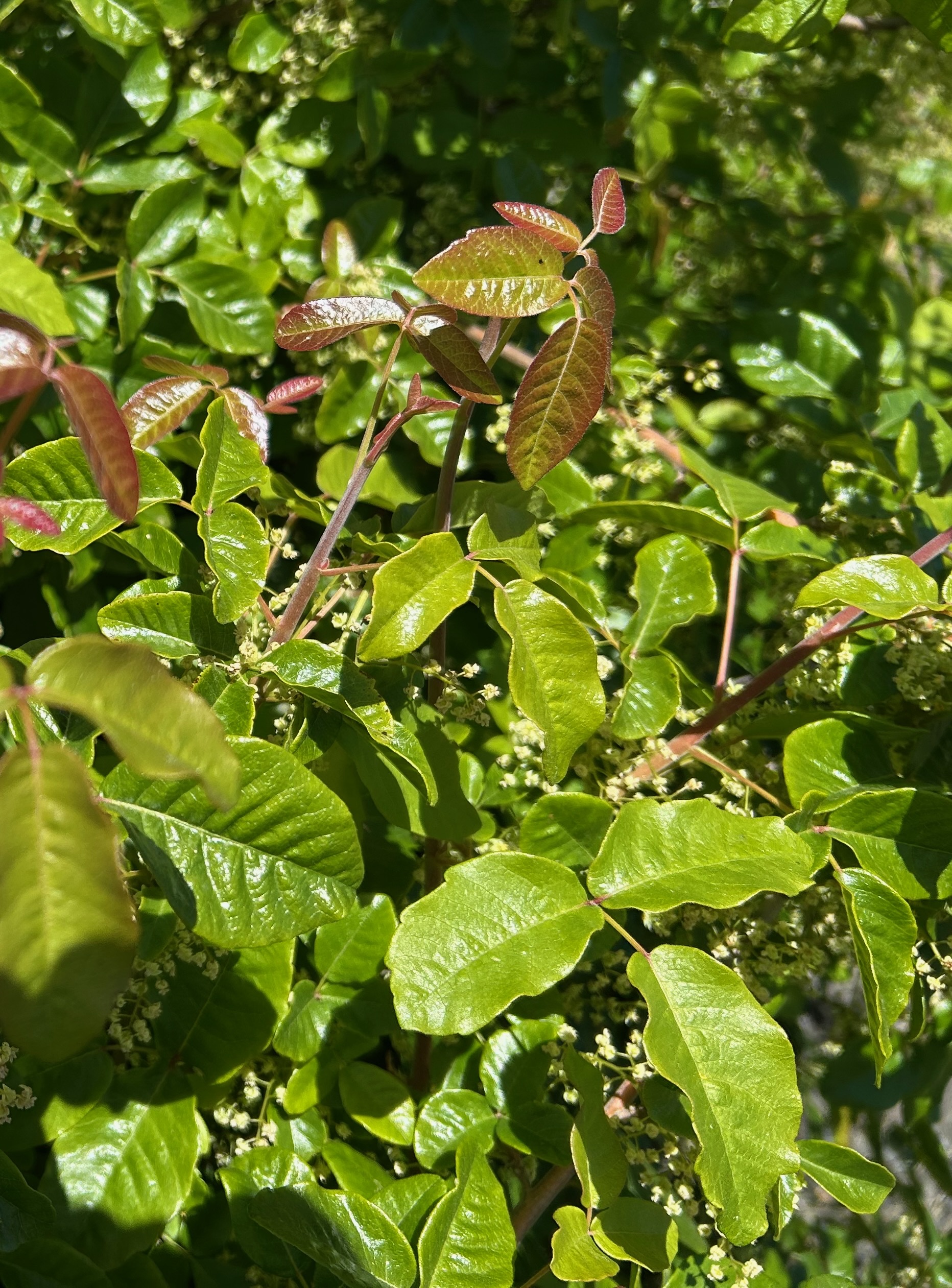
So it’s important to first properly identify poison-oak which is in the sumac family, and having the scientific name Toxicodendron diversilobum. Pacific poison-oak has many growth forms and leaf shapes, depending on their environment. It can grow as a shrub reaching 3-10 feet tall in height or grows as a woody vine that can climb into and around trees up to 100 feet. Fortunately this plant is easy to identify. Leaf color varies from green with hints of red when young to dull or shiny green, turning bright red in the fall. The leaf surface can be glossy or blistered in appearance, and each alternate leaf is typically made up of three leaflets, 1-6” long, resembling oak or ivy leaves. Leaflet lobes are often irregular and can vary even on the same plant.
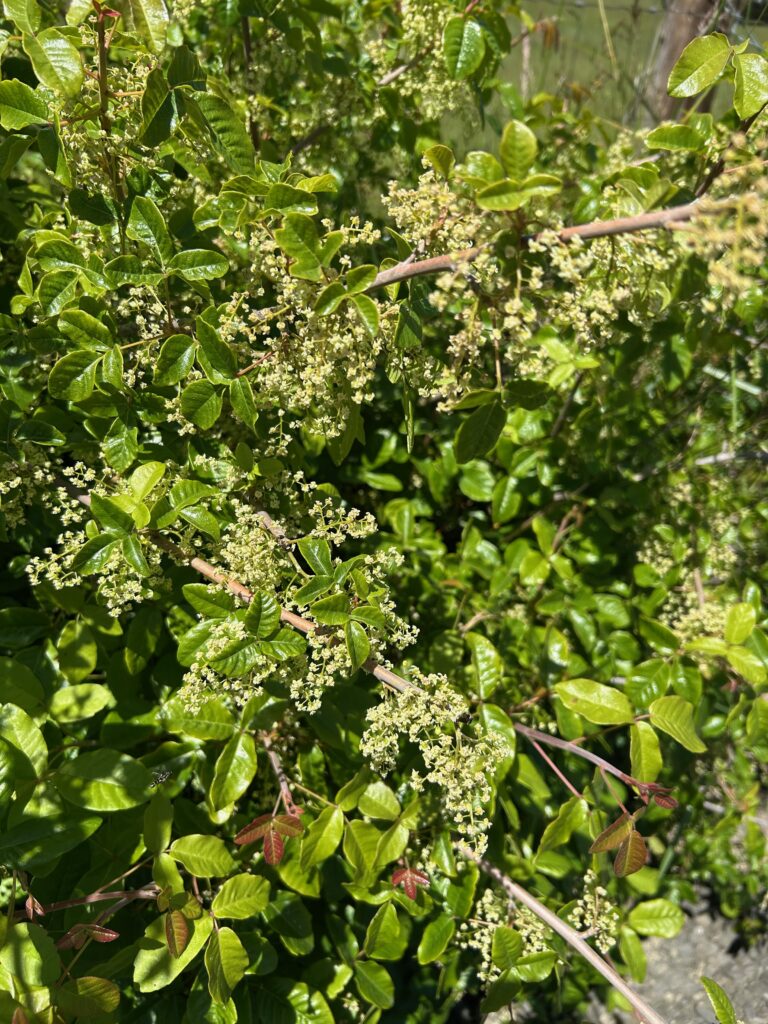
Poison-oak reproduces by seed and by underground rhizomes. Flowers are greenish-white, 1/4” across, and arranged in clusters on a slender stem. You may notice that poison-oak is now in bloom locally. These flowers develop into white, berrylike fruits with a striped seed inside the papery shell.
Okay, so what to do. If you have poison-oak in your pasture and have goats, you’re fortunate because goats are great at feeding on this pesky plant. But since most of us don’t have goats, here’s what can be done to get rid of it.
It goes without saying, that with any method you choose, be sure and wear protective clothing. Wear vinyl gloves and loose-fitting clothing or coveralls. Avoid touching or rubbing against any part of the plant unless you are “armored up”. The oil can remain noxious for long periods of time on your gloves or other clothing, tools, equipment and even firewood. After handling poison-oak, wash any clothing that’s come in contact with the plant with soap and water – separately from your other clothes. If your skin is exposed, immediately wash the area of your skin with soap and COLD water. Never use warm water as that increases the absorption rate.
And be aware that your pets and other animals can be exposed to the oils of the plant by coming in contact with it, so if you suspect that, wash them with soap and water, using gloves, to remove the oil. Don’t pet them until you do or you may end up with transferring the oil to your hands and face.
So much for the cautions. There are different ways to eradicate poison-oak. The first is by digging it out in the spring or fall when the soil is wet from the rains. Remove all the roots you can as any remaining root will produce a new plant. Bag it up and haul it to the dump. (Obviously never burn it!) If the poison-oak is climbing like a vine up your tree, simply cut the vines at the base.
Then there’s chemical control using brush-management herbicides containing active ingredients or mixtures of these ingredients: glyphosate, dicamba, triclopyr (alone or combined with 2,4-D). Use caution with products containing non-selective glyphosate as it can kill or injure all plants, while the others are selective only for broadleaf plants. Foliar treatment should be done in the late spring or early summer when poison-oak is in full leaf. Any regrowth or missed plants should be resprayed the same year during the fall, prior to leaf drop. Effective treatment of the lower stems with herbicides during the winter is also possible and relatively safer than in other times of the year as the plant has leafless stems with less chance of the applicator’s exposure to the oils. Remember herbicides may drift, so apply on a day with little or no wind, and when the temperature is below 85 degrees for the day. With any herbicide, always read the label thoroughly and abide by it – the label is the law. Repeated applications, like with most unwanted vegetation, may have to be continued over several years for complete control.
Do you have a gardening or insect question? Contact the Douglas County Master Gardeners at douglasmg@oregonstate.edu or 541-672-4461 or visit 1134 SE Douglas Ave., Roseburg. Douglas County Master Gardeners are trained volunteers who help the OSU Extension Service serve the people of Douglas County.