

Published in the News-Review May 2, 2025
By: Bonnie Courter
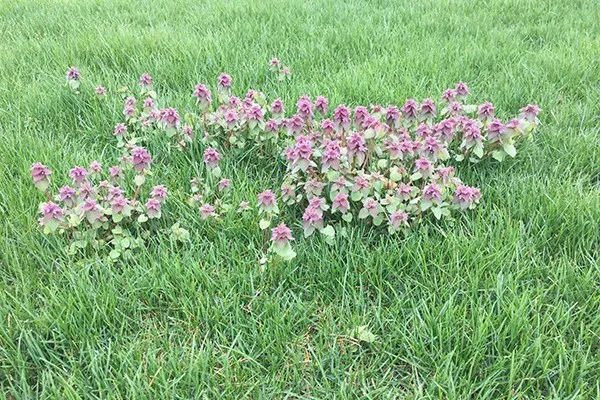
Question: It’s spring, and I’m on a mission to get control of the weeds that are taking over my lawn. One of these weeds that is particularly pesky, and that I seem to see everywhere, has little pink flowers and purplish leaves. What is it, and what can I do to control it?
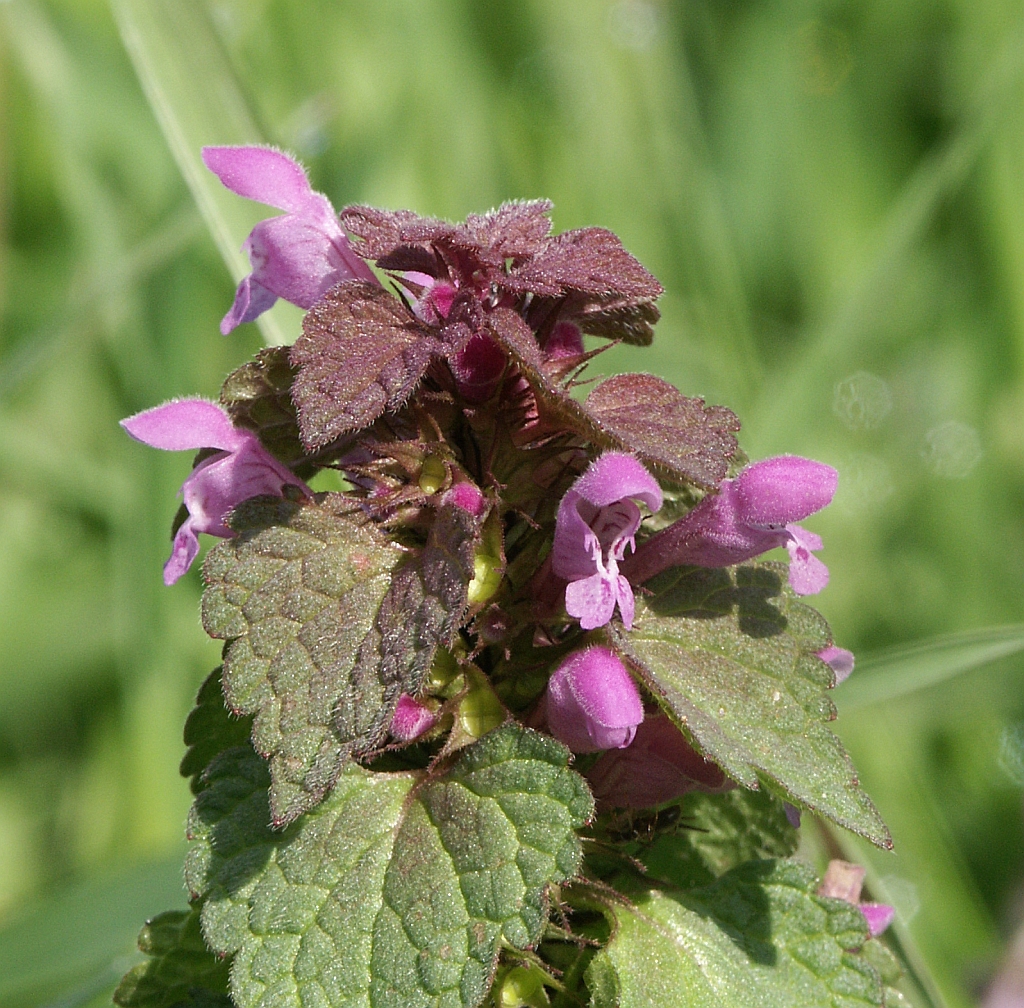
Answer: From your description and the photo you sent me, what you have is called Red Dead Nettle, Lamium purpureum. Other names are Purple Dead Nettle and Purple Archangel. It is considered a flowering, winter annual (though sometimes a summer annual), and a member of the Mint family. No, it’s not a nettle with its stinging hairs, but because the leaves are hairy, it does resemble members of the Nettle family.
Considered a common lawn weed, its origins lie in the Mediterranean, Europe and Western Siberia, but is an introduced species to North America, and even Greenland and Japan.
Red Dead Nettle thrives in moist soils and full to moderate shade, preferring moist fallow fields, ditches, gardens and various kinds of disturbed ground. A cool season annual weed, you will find it popping up in flower in early spring, especially in the month of April. Young plants emerge following seed germination in the fall, live through the winter as seedlings, and grow to rapid maturity in the spring. Because it blooms so early, it can be a good early source of nectar for foraging bees. By late spring or summer, it will die back as temperatures rise.
This plant tends to grow in patches due to its spread by horizontal stems or stolons that grow along the soil surface as well as reseeding. The stems are four-sided that extend above the turf canopy. Leaves, as mentioned, are covered with fine hairs, giving a fuzzy appearance, with indented veins. Flowers are tubular, about 1/2” in length and having protruding upper and lower lip-like appendages. Flowers are mostly pink or purple in color, and bloom into mid summer. Of course, being a weed, it is little bothered by disease or insect pests.
Interestingly, Red Dead Nettle has a long history in traditional herbal medicine, valued for its medicinal properties and applications. The tops and leaves are edible and can be used in salads or stir fry. Folk lore used the fresh leaves, which have an astringent property, as a poultice to minor wounds, cuts and abrasions to help stop bleeding. It is an anti-inflammatory, antibacterial and antioxidant, containing polyphenols and flavonoids. Red Dead Nettle can be used as a mild laxative and to support gut health, but only in small quantities. This diuretic property can be used by making a tea or infusion from fresh or dried leaves steeped in hot water.
But as far as this weed taking over your lawn, it happily can be easily controlled. The key is to increase your turf density to keep weeds out. Follow proper cultural steps for your lawn by frequent mowing at a 2-3” cut in early spring to remove the flower stems, fertilizing at the right time and providing warm-season grasses with one inch of water a week. This will reduce any thinning areas which Red Dead Nettle loves to take advantage of.
Since this is a cool-season annual and May is when it is still in bloom, this is not a good time to use any herbicides. Instead, it would be better to plan on using a pre-emergent herbicide, one that prevents the development of broadleaf weeds, in the fall. If the weeds are already small, you could use a post-emergent herbicide in the fall and then again in early spring before your lawn starts to green up. Of course, regardless of which herbicide you choose, always follow and read all label directions. For any bare areas created by killing off the weeds in the lawn, be sure and fill those back in with re-seeding or using sod sections. Otherwise, you’re sure to see new infestations.
Do you have a gardening or insect question? Contact the Douglas County Master Gardeners at douglasmg@oregonstate.edu or 541-672-4461 or visit 1134 SE Douglas Ave., Roseburg. Douglas County Master Gardeners are trained volunteers who help the OSU Extension Service serve the people of Douglas County.