


Published in the News-Review September 19, 2025
By: Bonnie Courter
Question: My neighbor has this bush that is covered in beautiful large flowers. I thought it was a hibiscus but she said it’s called the Rose of Sharon. Which one of us is right, and can you tell me more about it?
Answer: You’re both right! A common name for it is Rose of Sharon, but it is not a rose. (You may recall the name from the Bible in The Song of Solomon, “I am the rose of Sharon, the lily of the valleys.”). The scientific name is Hibiscus syriacus, of the mallow family and looks like a smaller version of the hibiscus you might see in more tropical climates. Other common names are Rose of China and Althea.
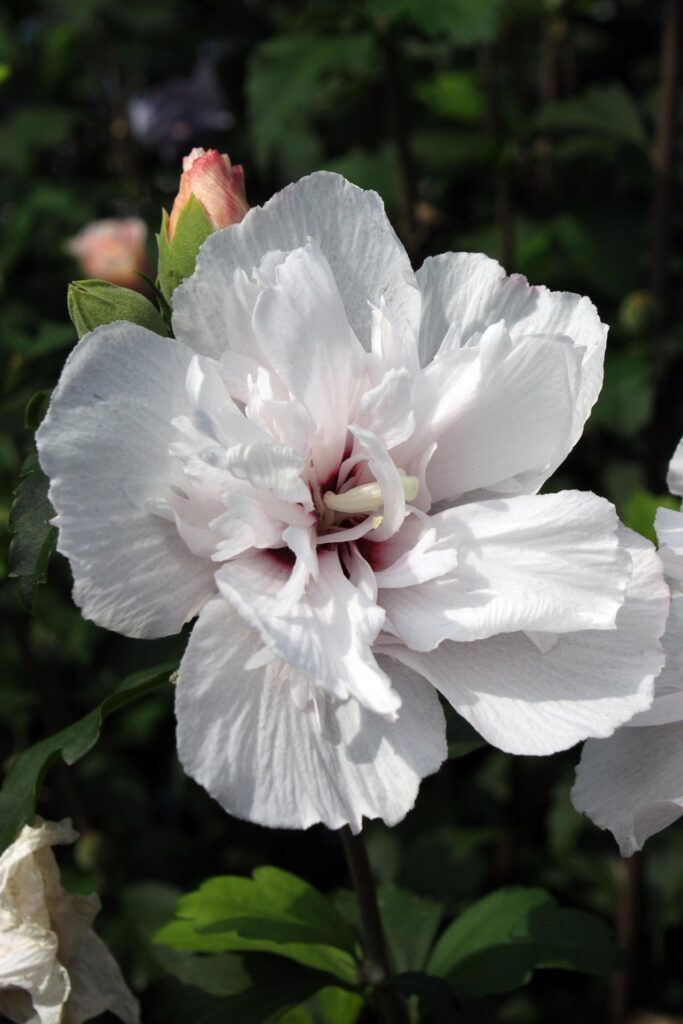
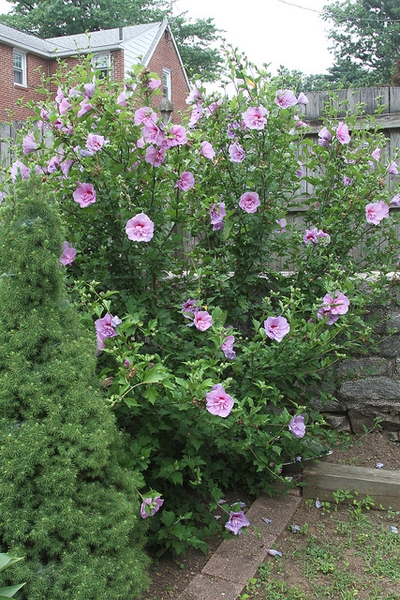
Native to south China and Taiwan, this shrub or tree is deciduous, unlike tropical hibiscuses. It grows 8-12’ tall and 6-10’ wide, and does well in USDA hardiness zones 5B through 9A. Rose of Sharon’s main attraction are the gorgeous, large flowers they produce. Flowers have five petals that come in shades of pink, red, rose, white and violet with many having an attractive contrasting dark-red “eye”. Besides the beautiful petals are the prominent column of stamens and pistils so characteristic of hibiscus. Leaves are green, 3-lobed, 2-4” long with simple, alternate and coarsely toothed edges.
Flowering from summer well into the fall when other plants are done blooming, Rose of Sharon will give you a long-lasting display of color. Individual flowers stay open for one day, closing at night. This is a wonderful shrub to plant to add to your landscape if you want to attract pollinators. The flowers attract butterflies, specialized bees and hummingbirds as well as being a wildlife food source. Single-bloom cultivars give pollinators an easier job of it than the frilly double-bloom varieties.
Rose of Sharon has an upright habit with open, loose branches that doesn’t need much pruning. It can be shaped, however, during the dormant season as it blooms on new wood, but the plant grows slowly and keeps a tight upright form. This plant can be in shrub form with multiple branches or pruned to a single trunk for the look of a small tree. Planting Rose of Sharon in multiples 6-12’ apart can create a showy hedge.
Smaller varieties of Rose of Sharon can be planted in large containers and make an excellent accent to a patio or outdoor living space.
Plant in locations with full sun to partial shade, though in shade, you minimize flowering and possibly subject it to fungal diseases. A heat lover, but also tolerant of winter below freezing temperatures, it can also tolerate poor soils and drought which makes it ideal for many landscapes. However ample moisture will cause it to flower at its best and avoid leaf drop.
A few popular varieties of Rose of Sharon are:
- ‘Blue Chiffon’: Double flowers with a purple-blue tinge blooming from mid-summer into fall. It grows 8-12’ with a spread of 6-10’.
- ‘Sugar Tip’: This cultivar has variegated leaves with creamy-white edging. Pink double flowers, growing 6-8’ tall and 4-6’ wide.
- ‘White Chiffon’: This variety has solid white flowers with no contrasting throat.
- ‘Red Heart’: Flowers are ruffled and feature white petals with dark red centers.
- ‘Lil Kim’: A dwarf variety suited for small spaces, compact and dense, only reaching 3-4’ tall. This variety would be great for containers too.
So if you’re looking for a touch of the tropics in your garden, consider planting Rose of Sharon this fall.
Do you have a gardening or insect question? Contact the Douglas County Master Gardeners at douglasmg@oregonstate.edu or 541-672-4461 or visit 1134 SE Douglas Ave., Roseburg. Douglas County Master Gardeners are trained volunteers who help the OSU Extension Service serve the people of Douglas County.