



Published in the News-Review August 15, 2025
By: Bonnie Courter
Question: I’m thinking of introducing some Shasta daisies to my flower garden next year. Do you have any pointers for me?
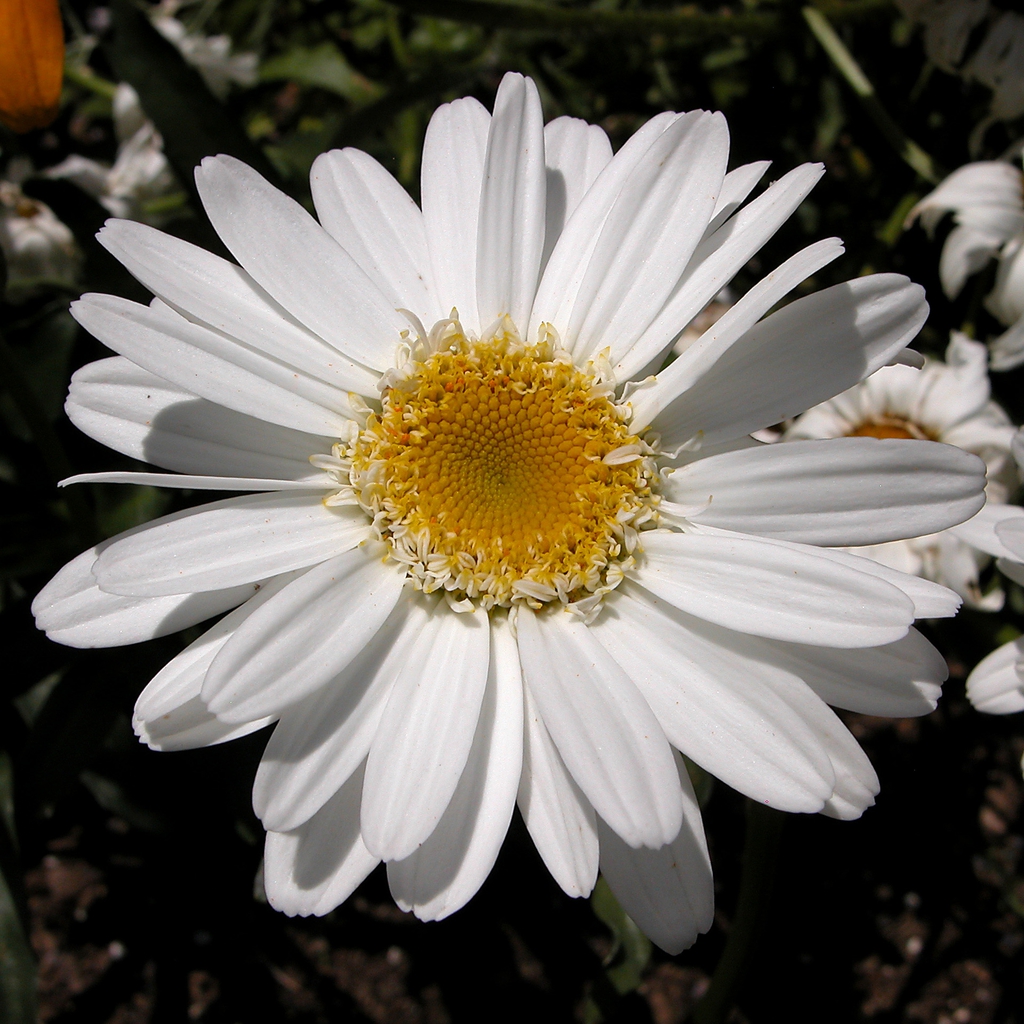
Answer: I personally love Shasta daisies. They have such cheery flowers with their white petals and yellow centers. They bring back fond memories of my grandmother’s garden. She would pick a flower and we would play the “he loves me, he loves me not” game together, plucking each petal until we found the answer whether that romance would blossom or not. Shasta daisies are an old-fashioned favorite for perennial borders and long-lasting cut flower arrangements, with single and double-flowered cultivars available.
Known botanically as Leucanthemum x superbum, the Shasta daisy is a hybrid of the oxeye daisy from Europe and named for Mt. Shasta in California where it was developed in the 1890’s by botanist Luther Burbank. It is a hardy perennial that loves full sun with a dry, well-drained soil. Shasta daisies do not like wet or heavy soils, but in summer will appreciate a layer of mulch to keep the soil cool. They’re very easy to maintain as well, deer resistant, but also toxic to dogs and cats. They also attract bees and butterflies which is always a plus.
Shasta daisies can grow up to a height of 4 feet, so keep that in mind when planting them in your garden. Tall varieties are best suited towards the back of the perennial border or along fencing. However, there are cultivars that grow to only a foot tall. Plants should be spaced 1-3 feet apart. They will remain evergreen through the winter and start new growth in spring, blooming throughout the summer and sometimes into the fall.
What my grandmother didn’t tell me about the Shasta daisy, however, is that if left to itself to reseed or propagate, it can take over your garden area! I had a lovely flower garden area with foxgloves, calendulas, poppies, Sweet Williams, larkspur, and bachelors buttons. But within two years, the Shasta daisies had completely crowded out everything else! So be warned! Shasta daisies should be deadheaded so they don’t go to seed, and divided every other year in late fall or early spring when plants are dormant to keep them under control and healthy. Regular division also benefits flower production. After flowering is done for the season, cut back the stems to just above the leaves at the base to increase longevity and prepare for the cold of winter.
Here’s how to divide a mature plant:
- Carefully loosen the soil around the plant with a shovel or garden fork until you can lift up the entire root ball, and remove the whole plant.
- Using a large knife, garden fork, or sharp shovel blade, cut through the root system vertically, making sure all divisions have both roots and foliage.
- Plant these divisions back in the ground, adding some compost as you do so. You can also plant divisions in an appropriately sized container or planter using fresh potting mix.
Some of the many varieties of Shasta daisies are:
- ‘Becky”: A large variety that can get up to 4’ tall, but sturdy enough not to need staking, and resistant to phytophthora.
- ‘Snow Lady’: This is a dwarf cultivar reaching 9-12” tall with abundant blooms.
- ‘Crazy Daisy’: A double-bloom cultivar with frilly petals that grows up to 30” tall.
- ‘Daisy May’: Has large flowers with good branching, producing flowers over a long period of time, and has a compact habit suitable for borders, small spaces, or containers.
Companion plants that look spectacular with Shasta daisies are purple coneflowers, black-eyed Susans, bee balm, lavender, and Russian sage.
Do you have a gardening or insect question? Contact the Douglas County Master Gardeners at douglasmg@oregonstate.edu or 541-672-4461 or visit 1134 SE Douglas Ave., Roseburg. Douglas County Master Gardeners are trained volunteers who help the OSU Extension Service serve the people of Douglas County.