
Published in the News-Review May 23, 2025
By: Chris Rusch
Growing Romanesco in your home garden
Question: Is Romanesco a broccoli or a cauliflower? Can you give some recommendations for growing this unusual vegetable in the Umpqua Valley?
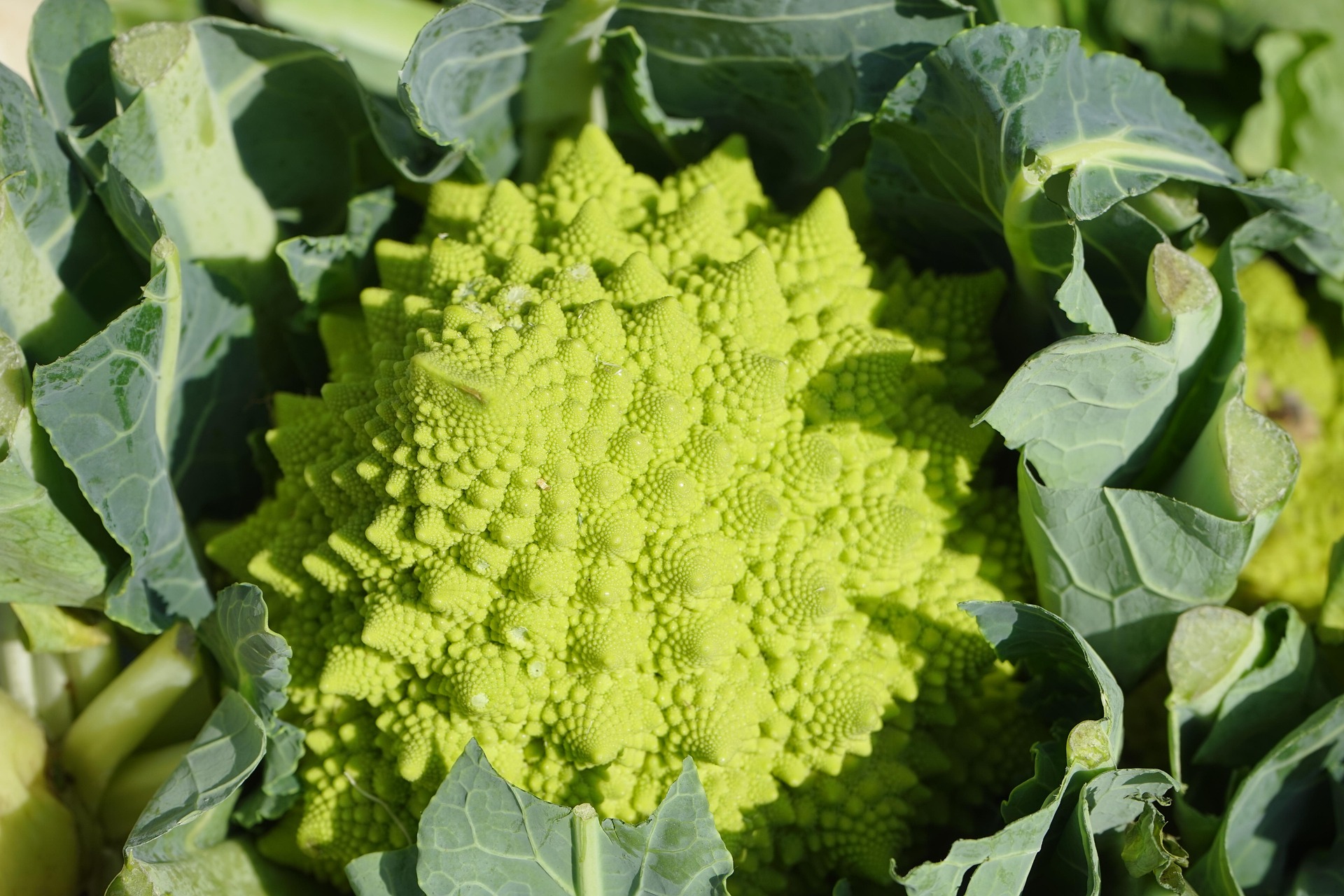
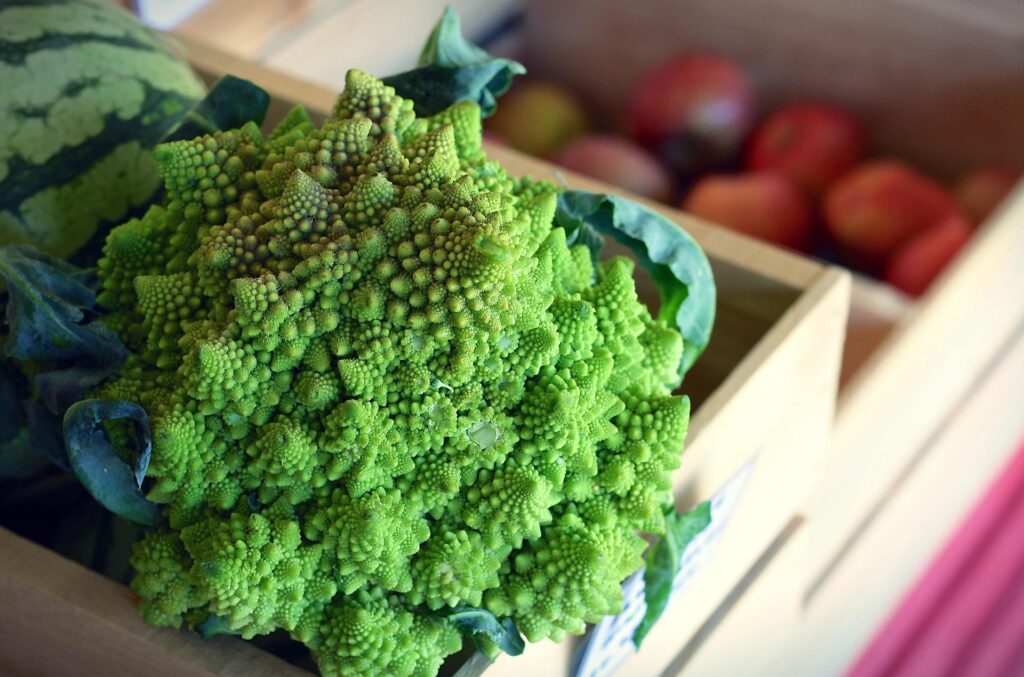
Answer: Romanesco, also known as broccoflower or Roman cauliflower, is a chartreuse, unique-looking vegetable prized for its appearance and mild flavor. It is a glamorous cousin of the humble cabbage family (family Brassicaceae, genus Brassica). It is sometimes assumed to be a hybrid between broccoli and cauliflower, but although related, it is botanically different. Brassica oleracea var. botrytis ‘Romanesco’ is the classic Italian Romanesco, with distinctive lime green heads made up of numerous geometric florets. It’s a beautiful and unusual vegetable and is becoming increasingly popular. The flavor is like that of cauliflower, but it is milder, nuttier and has a crunchier texture.
The history of this veggie alone renders it a pedigree. It’s been around for a while – Romanescos date as far back as 16th century Europe. That’s right, this futuristic looking vegetable comes from the 1500’s! It has a naturally occurring fractal pattern, lending to its trademark nuance and attractiveness. Each bunch of Romanesco is made up of smaller buds that build over and over each other, which renders Romanesco its recognizable peaks. This phenomenon is also why this flower never blooms! Disturbances in their genetics cause the plant to keep repeating its budded pattern without fully blooming, thus creating its shape. The unique, spiraled structure of Romanesco is an example of a fractal, demonstrating the Fibonacci sequence in nature. The Fibonacci sequence, where each number is the sum of the two preceding ones (e.g., 1, 1, 2, 3, 5, 8), is a mathematical sequence that surprisingly appears in various natural phenomena. These include the spiral patterns of sunflower seeds, pinecones, and nautilus shells, as well as the branching of trees.
It is a native of Italy where it was born of selective breeding in the 16th century by farmers in the Lazio region of Italy, who purposely selected plants with naturally spiraled heads. The name “Romanesco” is thought to be related to Rome, the capital of Lazio, and a dialect spoken in the area. Today, Romanesco is still cultivated in Italy, France, Spain, and Germany. While primarily an Italian vegetable, Romanesco eventually made its way to the United States in the early 20th century.
To grow Romanesco, it is best to start the seeds indoors 4-6 weeks before the last frost. Once your seedlings are 4-6 inches tall, transplant them outdoors. Be sure to choose a location with well-drained, fertile soil, amended with compost or manure. Romanesco prefers a soil pH between 6.0 and 7.5. At least 6 hours of sunlight is required for your plants to reach their full potential. Space plants 18-24 inches apart. Water well after planting. Fertilize once or twice during the growing season with liquid fertilizer. Be sure to provide your plants with consistent moisture, especially during hot periods. Regularly inspect your plants for common pests, including aphids and cabbage caterpillars, and implement suitable measures to manage them. If the heads are exposed to direct sunlight, Romanesco can turn purple; you can blanch the head by covering it with the outside leaves. Romanesco heads are ready for harvest 75-100 days after transplanting. The heads can be quite large, up to 5 pounds each. If you want a fall crop, plant Romanesco seed in late July to early August.
One of the advantages of cultivating Romanesco is its resilience and adaptability to various climates. It requires less water and has a higher tolerance for pests compared to other vegetables, making it an environmentally friendly crop to grow.
Cherished by chefs, Romanesco is one of the more mysterious, nutrient-dense, and fabulous produce pieces around. Romanesco offers a delightful crunch and a slightly nutty flavor, making it a versatile ingredient in the kitchen. It can be enjoyed raw in salads, roasted to bring out its natural sweetness, and steamed or sautéed for a delicious side dish. It is often used as a visually striking centerpiece in vegetable platters. It is an excellent source of vitamin C, vitamin K, dietary fiber, and carotenoids for chefs leaning into healthier menu ideas.
Planting Romanesco is a great way of providing variety in your family’s diet. Looking like an elaborate work of art or alien from space, Romanesco is an uncommon vegetable frequently available only at local Farmer’s Markets or to grow from seed. These unique neon-colored plants are a kid favorite. Grow some Romanesco this summer and expose your friends and family to this terrific vegetable.
Do you have a gardening question? Please email, call, or visit the Douglas County Master Gardener Plant Clinic at douglasmg@oregonstate.edu, 541-672-4461, or 1134 S.E. Douglas Ave., Roseburg. Douglas County Master Gardeners are trained volunteers who help the OSU Extension Service to serve the people of Douglas County.