

Published in the News-Review October 24, 2025
By: Bonnie Courter
Question: I’ve been successful in attracting hummingbirds to my feeders this year. I thoroughly enjoy watching them as do my children. My question is, with winter and freezing temperatures approaching, should I keep feeding them, or do they all start migrating south?
Answer: Hummingbirds are such a wonderful addition to our gardens. Weighing less than a nickel, they also play a part in pollination. To answer your question, there are usually only two species of hummingbirds that are found in our area – Rufous and Anna hummingbirds. Rufous hummingbirds migrate to Mexico and Southern California in the winter, whereas Annas will stay here locally through the winter months. Therefore, you should continue to fill your feeders throughout the winter to supply the Anna hummingbirds with necessary nectar when all other sources of food have died out. Watch the weather forecast for upcoming freezing temperatures, and then be sure and bring your feeders inside during those periods, replacing them mid-morning when temperatures rise. I remember forgetting to do so and, upon waking up, facing a very angry hummingbird perched on the feeder, glaring at me because he couldn’t get any nectar!
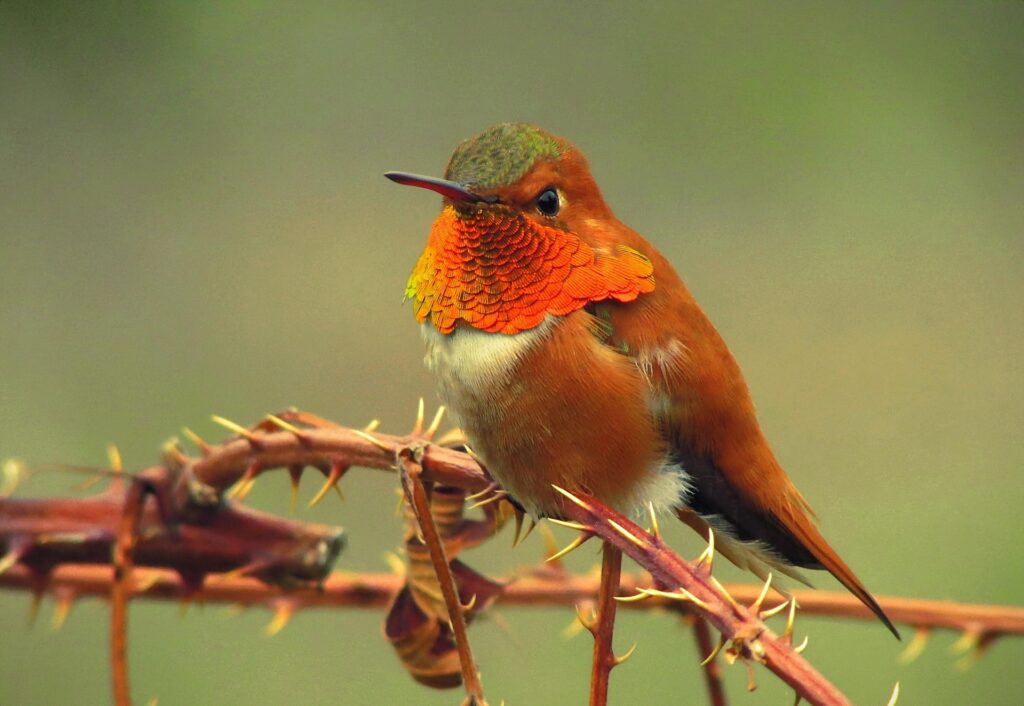
Let’s talk about the Rufous as opposed to the Annas. Rufous hummingbirds will arrive in the spring from Mexico, timed with the blooming of manzanita and Indian plum. They are brighter in color than the females having a rusty red head, sides, tail and lower belly, white chest and a iridescent orange-red throat called a gorget. (The males use their gorget to attract mates and keep intruders away). You’ll know they’ve arrived because Rufous hummingbirds are very territorial and “fight” over the feeders, keeping others away with flight displays, loud buzzes and high pitched notes. (Makes you wonder how any of them even get a chance to feed!)
Rufous begin nesting in June or July, using small pieces of plant down and soft materials for their tiny nests (1-1/2” across) which are held together by spider webs! Two eggs the size of a jelly bean are laid, and after two weeks of incubation, the babies hatch. The mother must feed them with tiny insects and regurgitated nectar for the first few weeks. They may have two broods each breeding season, unlike Annas which have only one.
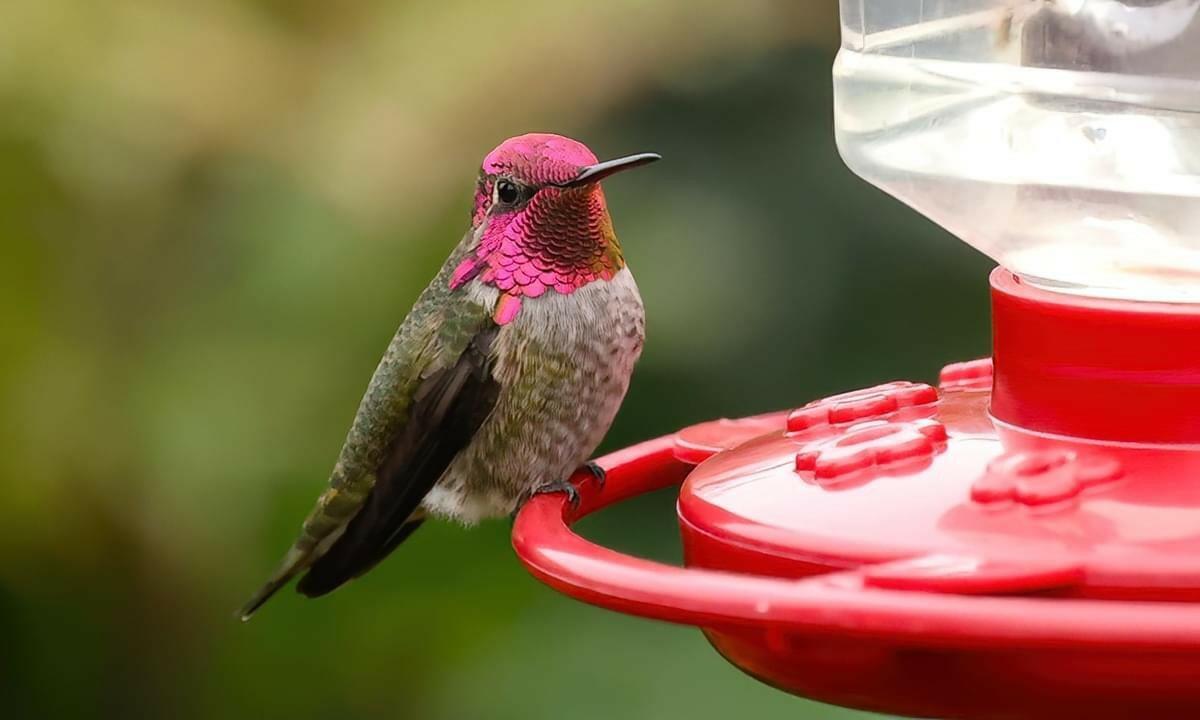
Male Anna hummingbirds are mostly green and gray. Their head and throat are covered with iridescent reddish-pink feathers. The female has a tiny red gorget, unlike the other female species which have none. The female will lay eggs from November to June. The male courtship display involves climbing vertically 130’ into the air, swooping straight down to the ground which causes a loud burst of noise like a sonic boom. This dramatic sound is produced by their tail feathers.
Hummingbirds may live up to 5 years or more because they can slow down their bodies at night and in cold weather. At these times, they enter a state of torpor, a trancelike state where they may appear dead – if found in such a state, leave them alone as they are still very much alive. During the day, their heart beats more than 1,200 times per minute, whereas in torpor, their heart rate can slow to 50 beats per minute.
For hummingbird feeders, I’ve found the plastic saucer-shaped feeders are the most popular with these energetic birds who need to feed every 10 minutes. And because they are so territorial, 4-5 of these smaller feeders are better than having only one large one with many ports. Space them around your house or yard. Also avoid placing the feeder in direct sun as that can cause the sugar solution to spoil rapidly. The yellow bee guards on some models actually tend to attract bees, not deter them. Never use red food coloring in your nectar solution – the food coloring has been known to be toxic to them. The red plastic color of the feeder is sufficient to attract. Use 1 C. cane sugar to 4 C. water (in winter, you can use 1.5 C. sugar to 4 C. water). I use hot tap water to dissolve the sugar thoroughly and bring to room temperature before filling the feeder. It’s important to clean the feeder and put new sugar water in it every 4-5 days to avoid any mold growing in it.
Hummingbirds like to bathe in birdbaths. Scatter some smooth rocks in a corner to form a shallow pool so the water is only 1-2” deep.
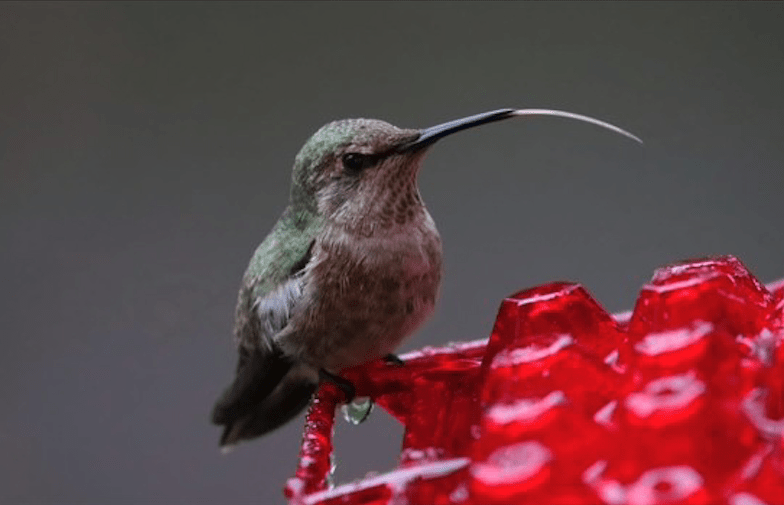
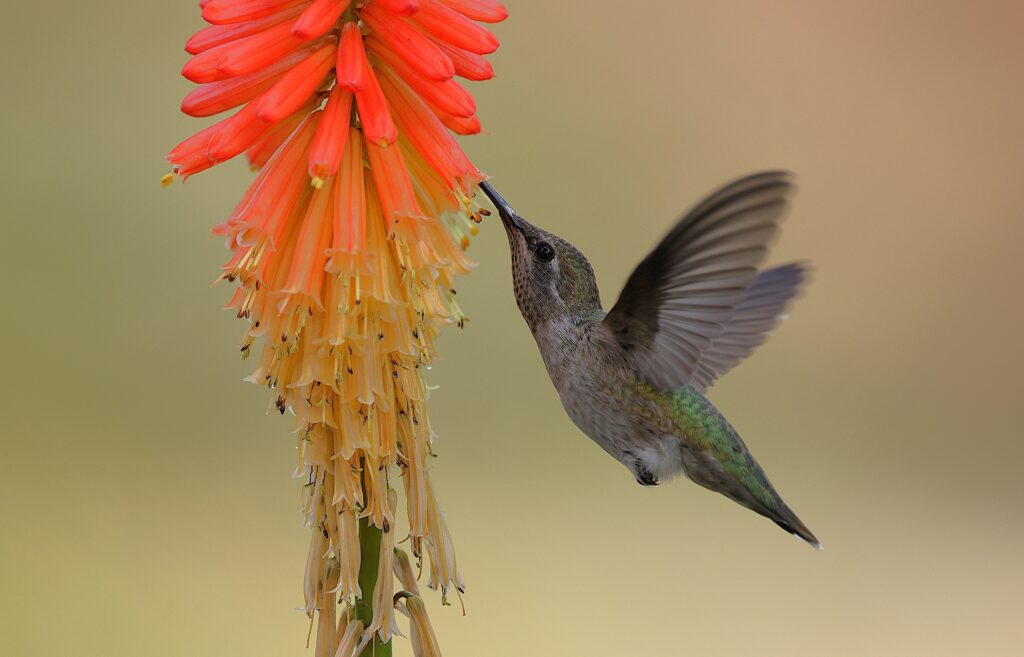
An ideal hummingbird garden provides a diversity of feeding opportunities as they feed not only on sugar water but flower nectar, tree sap, insects in sapsucker holes, small insects and spiders. Trees and shrubs, especially natives, that are spaced in the landscape, avoiding large gaps between plants, provide connectivity and biodiversity. They are attracted to red, pink and orange flowers. Hummingbirds love manzanita, honeysuckle, snowberry, columbine, bleeding hearts, fuchsias, penstemon, salvia, Western azalea, and chokecherry as a short list – especially flowers that are tubular that facilitate their long tongues to find nectar.
By keeping your landscape diverse and feeders available year-round, you will ensure that you will keep these aerobatic entertainers happy and healthy for years to come.
Do you have a gardening or insect question? Contact the Douglas County Master Gardeners at douglasmg@oregonstate.edu or 541-672-4461 or visit 1134 SE Douglas Ave., Roseburg. Douglas County Master Gardeners are trained volunteers who help the OSU Extension Service serve the people of Douglas County.